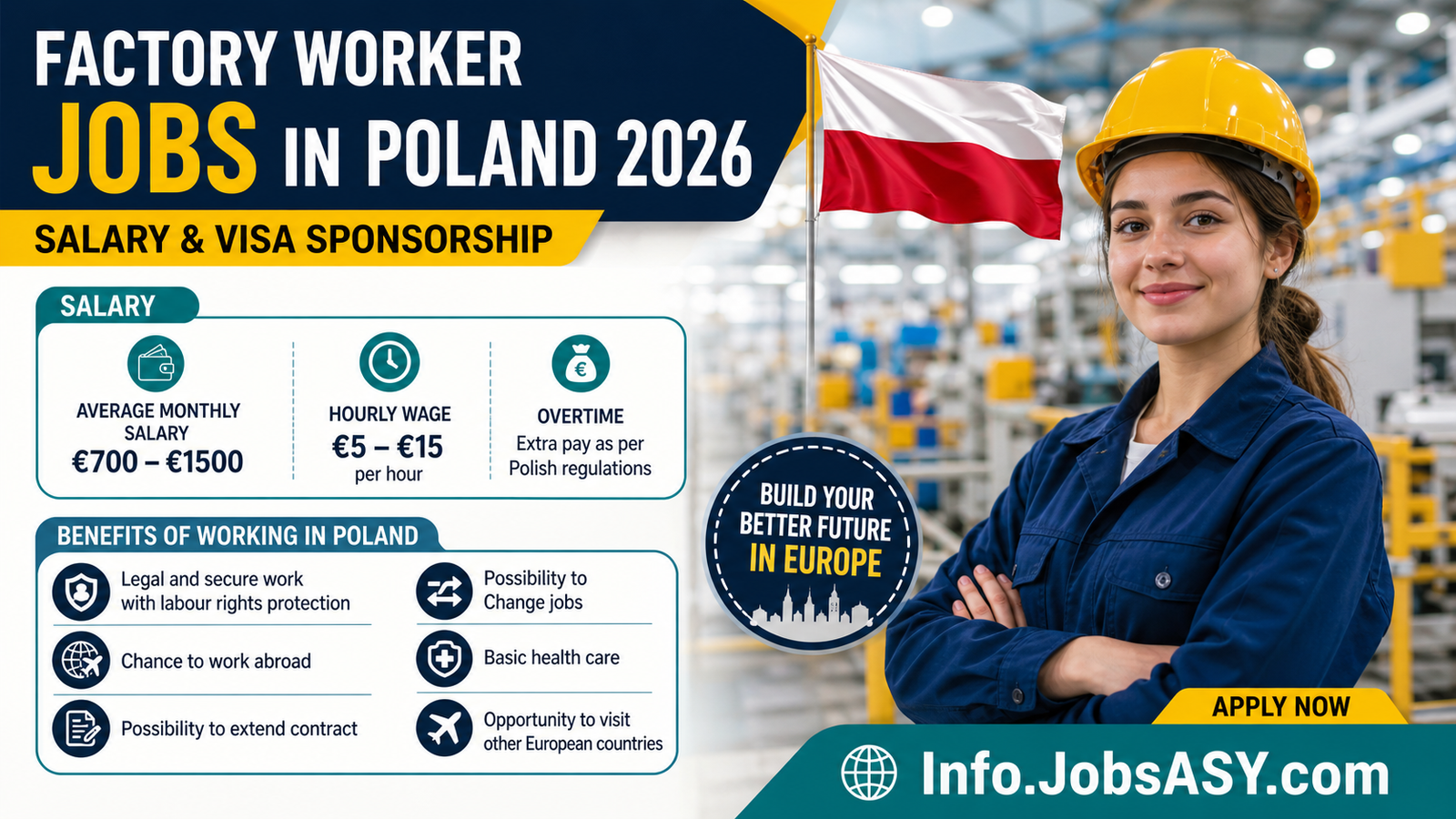
Factory Worker Jobs in Poland 2026 | Salary & Visa Sponsorship
For many job seekers, getting a secure job with visa sponsorship overseas is a dream, particularly if they aim to improve their quality of life. Factory Worker Jobs in Poland with free visa sponsorship 2026 have become increasingly popular in recent years because of the growing demand for workers and the ease of hiring foreign workers. But job seekers often face challenges in understanding the application process, eligibility criteria, and how to apply without the risk of being scammed.
Advertisement
This comprehensive guide will help with that. Here, we explain how Factory Worker Jobs in Poland, what employers expect from you, how they sponsor visas, and the application process for 2026. We’ll even discuss perks, wages, pitfalls and pro tips to maximise your chances.
Factory Worker Jobs in Poland 2026: An Overview
- Poland is rapidly emerging as a leading manufacturing destination in Europe, with both domestic and international businesses setting up shop. As industries grow, there is a steady need for Factory Worker Jobs in Poland in various industries including packaging, food processing, automotive assembly, textiles, and electronics.
- Polish Factory Worker Jobs in Poland positions are typically entry-level jobs, making them suitable for a broad spectrum of candidates, including those without degrees. Numerous employers provide visa sponsorship, meaning they help obtain work permits and other legal documents for non-Polish workers.
- Workers hold various positions, such as product assembly, machinery operators, inspectors, packers, or line workers. These jobs are often hard physical work, but provide regular income, legal working conditions and prospects for future growth.
- Poland will still be welcoming foreign workers for 2016 because of a lack of skilled employees, particularly in manufacturing.
Overview of Factory Worker Jobs in Poland 2026
- Widespread need for international Factory Worker Jobs in Poland
- Jobs without a degree required
- Offer of visa sponsorship by some employers
- Good salary offer compared to entry positions in other countries
- Legal work with protection under Polish employment laws
- Opportunity to prolong contracts or change jobs after some years
These points are just some of the reasons why Poland can be a viable destination for people seeking employment in the EU in a legal and orderly manner.
Read More: Restaurant Jobs in France 2026 | Salary & Visa Apply Guide
Poland Needs Factory Workers
- Poland’s economy is heavily reliant on the manufacturing industry. With the growth in foreign investments in Polish manufacturing, there has been a shortage of workers. This is one of the driving factors behind the recruitment of foreign workers.
- Furthermore, Poland’s geographical position in Europe enables exports, boosting production needs. There is also a seasonal need in labour-intensive industries, such as food packaging and processing.
- Workers from abroad help address these needs, ensuring production remains uninterrupted. This makes employers more willing to help with visas and immigration.
Types of Factory Worker Jobs in Poland Available
Polish factories offer a variety of positions. A few of the more prevalent jobs include:
- Production Line Factory Worker Jobs in Poland
- Assembles products, operates machinery, and meets production goals.
- Packaging Factory Worker Jobs in Poland
- Responsible for packaging, labeling, and shipping products.
- Quality Control Assistant
- Inspects products to ensure they are free from defects and adhere to company guidelines.
- Warehouse Support Staff
- Helps in storage, arrangement and movement of products within the manufacturing plant.
- Machine Operator (Entry-Level)
- Runs simple machines with limited training and supervision.
- The requirements for each position vary, but generally do not require extensive education, so they are easy for entry-level roles.
Working Hours and Salary in Poland
The wages of Factory Worker Jobs in Poland can differ according to experience, region and employer. On average:
- Average Monthly Salary: €700 – €1200 (net, including overtime)
- Hourly Wage: €4 – €7 per hour
- Overtime: Extra pay as per Polish regulations
The average working hours are 8-12 hours a day, on shift work (day and night). Employees typically have one day off a week.
Although the pay may be low compared to Western European countries, the lower cost of living in Factory Worker Jobs in Poland to save money in the long run.
Visa Sponsorship Explained
While visa sponsorship does not necessarily mean everything is free, it typically includes help from the employer to get:
- Work permit (Type A permit for foreign workers)
- Work contract or an employment offer letter
- Visa invitation letter
Often the employer pays for some of the visa fees and the applicant needs to pay for:
- Visa application fee
- Travel expenses
- Medical tests
It’s worth noting that legitimate employers do not demand substantial fees and do present legal papers.
How to Apply for Factory Worker Jobs in Poland
- Step 1: Find Legitimate Jobs
- Look into reputable job sites, placement agencies or corporate websites.
- Step 2: Create a CV
- Prepare a basic CV detailing any work experience, no matter how basic.
- Step 3: Apply Online
- Apply via the proper channels.
- Step 4: Interview (if applicable)
- Interviews may be held online.
- Step 5: Receive Job Offer
- Make sure this includes details about the job and employer.
- Step 6: Work Permit Processing
- Your employer gets your work permit in Poland.
- Step 7: Apply for Visa
- Apply to the Polish embassy in your home country.
- Step 8: Go to Work
- If successful, travel to Poland and start working.
Requirements for Factory Worker Jobs in Poland
The job requirements for most factories are:
- Minimum age: 18 years
- Good communication skills (sometimes not required)
- Good physical health to work manually
- Valid passport
- Clean criminal record
- Flexible to work shifts
Experience of working in a Factory Worker Jobs in Poland may be preferred by some employers, but is not always essential.
Read More: Top Hiring Countries For Foreign Workers 2026 | Full Guide
Benefits of Factory Worker Jobs in Poland
There are a few benefits of a Factory Worker Jobs in Poland:
- Legal and secure work with labour rights protection
- Chance to work abroad
- Possibility to extend contract or change jobs
- Basic health care
- Opportunity to visit other European countries (visa dependent)
These advantages make Poland an ideal launching pad for a long-term career overseas.
Factory Worker Jobs in Poland Living Cost
- Living costs matter more than pay when eyeing Polish factory roles offering visa help in 2026. Some chase wages alone, yet what remains comes down to rent, meals, and getting around town. While earnings look good on paper, real progress hides behind daily spending choices.
- Most months, life in Poland takes around €300 to €600, though what you spend ties closely to where you live and how you choose to live. While places such as Warsaw, Kraków, or Wrocław pull harder on your wallet, quieter towns often ease the pressure without much effort. Housing? Some factory jobs include rooms shared with others, sometimes even at lower rates – this cuts bills fast, quietly making days easier.
- Sticking to homemade meals keeps food bills under control. Getting around town? Public transit usually works well – plus it won’t drain your wallet. When workers watch what they spend, setting aside some pay each month becomes possible, particularly when housing comes from the job.
- Figuring out these expenses gives a clearer picture of what to expect, shaping how you manage money ahead of relocation. A good look at spending now guides choices later on. Knowing amounts involved removes guesswork when organizing funds for the move.
Where People Stay and How They Live
Most people coming from abroad find where they live really matters. Often, the company that hires them – or the group helping with paperwork – sets up rooms to share. Inside these places, you get what’s needed: a bed, space to cook, plus somewhere to shower. A roof shows up first on their list when settling into a new country.
Some key points about accommodation:
- Shared rooms (2–4 people per room are common)
- Some everyday pieces of furniture come with it. Electricity, water, and similar services are covered too
- Some workers pay nothing to live on site. Others see housing costs taken out of their paycheck
- Close to where people work – that helps. Sometimes it sits right by a bus stop or train line instead. Getting there feels natural, like part of the daily walk. No long detours needed. Nearness matters more than size most days. A short trip beats a wide space every morning
- Though comfort might be limited, safety and basic needs are usually met where workers stay. Checking lodging info ahead of time makes sense when considering a position.
Work Environment and Conditions
On their feet most of the day, Factory Worker Jobs in Poland handle items that aren’t too heavy but move them again and again. Tough work it is, yet rules in Poland protect those on the floor. Standing through shifts comes with limits because safety matters there.
Employers are required to provide:
- Safety equipment (gloves, helmets, uniforms)
- Training for machinery or production tasks
- Break times during shifts
- Fair payment for overtime work
Starting out on night shifts often feels tough. Yet time passes, bodies change. Most people find their rhythm after several weeks of such hours. Shift patterns settle into daily life more smoothly than expected.
Switching Jobs in Poland?
Applicants often wonder if switching jobs is possible once they reach Poland. It really comes down to the kind of work permit you hold along with your current contract.
In most cases:
A job authorization links only to one company at a time. It won’t transfer if you switch roles elsewhere. Each new position needs its own approval process. Without that step, working becomes unauthorized. The system builds around employer-specific sponsorship
- Switching roles could mean needing another permit
- Some workers can switch after completing initial contract terms
- Changing jobs means you need to stick to the rules so your visa stays valid. Talk to your boss or a lawyer before you decide anything.
Long Term Growth Possibilities
Even if starting out simple, plant work might open doors later on. Doing solid work plus sticking around could mean moving up for some folks
- Get promoted to supervisor roles
- Move into machine operator or technical positions
- Extend contracts for long-term employment
- After some time has passed, look into staying permanently.
Starting out in Poland might open doors across Europe, provided you gain solid experience and keep your job performance consistent.
Spot Real Job Offers
Nowadays more people want work overseas – shady deals pop up just as fast. Spotting real chances matters most when chasing factory roles in Poland, especially ones that include visa help for 2026.
Here are some signs of genuine offers:
- Official company email and contact details
- Written job contract with clear terms
- A job pass gets sorted out by the person doing the hiring. Someone else handles the paperwork so the worker can start legally
- No unrealistic promises or guarantees
Warning signs of scams include:
- Asking for large upfront payments
- No proper documentation
- Vague job descriptions
- Pressure to make quick decisions
Check who you’re working for first – never skip that step. Before moving forward, make sure the company is real.
Language Needs and Talking
Most plant positions won’t ask for strong English or Polish. Yet knowing how to follow short directions makes things smoother. When staff can talk with team leads, shifts tend to go easier.
Start small. A handful of simple Polish phrases makes everyday tasks easier – like buying groceries or catching a bus. Talking with coworkers? That becomes smoother too. With months passing, most people pick up more without even trying.
Taxes and Legal Duties
Most people coming from abroad to work in Poland must stick to the country’s tax rules. Paychecks often arrive after money has been taken out by employers for taxes. Workers see what is left once those amounts are removed.
Key points include:
- Income tax is automatically deducted
- Workers receive payslips showing deductions
- Legal employment ensures social security benefits
Besides knowing what’s on your payslip, getting clear on contract details shows exactly how much you earn along with what you’re entitled to. A closer look at these documents reveals more than just numbers – it uncovers the rules guiding your job conditions.
travel and moving advice
Starting life abroad on a job might feel tough, particularly if you have never left home before. Yet preparation helps ease the shift.
Some practical tips:
Bring every document you own, along with duplicates. Take the real ones plus extra versions just in case
- Keep emergency contact numbers
- Exchange some currency before travel
- Learn basic local rules and customs
- Stay connected with family for support
Ready means less worry, also smoother start where you land next. A plan eases the jump into different surroundings.
How to Speed Up Selection
Trying several companies at once beats waiting for a single yes. One door closes, another might already be open. Spreading out increases chances without extra effort. When one says no, others could still say yes. Focusing everywhere means never putting all hope in just one place
- Keep your CV simple and clear (avoid unnecessary details)
- Watch out for false job ads that demand big money up front
- Improve basic English communication skills
- Respond quickly to employer emails or messages
- Check official sites regularly to keep track of visa rules
Staying steady while keeping your eyes open makes selection more likely. What matters is showing up the same way each time, yet noticing what shifts around you.
Read More: Housekeeping Jobs in Dubai 2026 | Salary & Visa Guide
Common Mistakes to Avoid
Most people get turned down – or worse, tricked – because of errors they could have sidestepped easily
- Applying through unverified agents
- Paying large upfront fees without documentation
- Submitting incomplete or incorrect documents
- Ignoring contract details
- Expecting unrealistic salaries or instant approvals
Watch your step when handling money, knowing what’s going on helps dodge trouble later. A little attention now prevents big regrets down the road.
FAQs
- Are Factory Worker Jobs in Poland available without experience?
- Finding a starting Factory Worker Jobs in Poland often means no past work is needed – yet knowing the basics might help you stand out. Some roles open their doors wide, but small skills could tilt things in your favor.
- Visa help – does Factory Worker Jobs in Poland it actually exist?
- Not every company covers all costs, yet many help with visas. Workers might pay some fees themselves, even when the job offers assistance.
- Bringing Family to Poland if i have Factory Worker Jobs in Poland?
- Working legally for some time often opens the door to bringing family later. The chance to do so ties closely to both visa rules and employment terms.
- How long does the visa process take for Factory Worker Jobs in Poland?
- Most people wait between four and eight weeks. The exact time depends on how fast the embassy moves plus what papers are needed.
- Poland safety for foreign workers?
- Folks often find Poland a secure place, while job rights rest on solid legal ground.
Final Thoughts
Still in 2026, Factory Worker Jobs in Poland staff looking for steady work overseas without tangled rules at the door. Getting there takes time, yes, yet clear paperwork opens paths just the same. Not every detail falls into place fast, still determination helps candidates move forward. Success often follows those who treat each step like part of a longer walk.
Success begins when you see how things actually work, skip the quick fixes, because knowing what’s happening matters most along the way. When ready, Poland might just be where your path abroad truly takes off.